
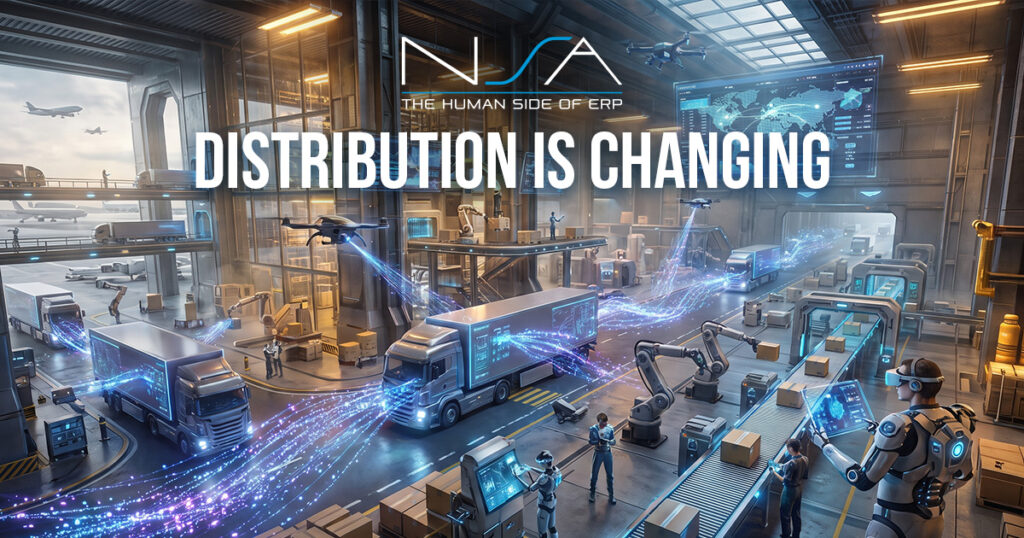
Distributors have always operated in an environment where speed, service and efficiency matter. What has changed is the number of demands businesses are being asked to manage at the same time.
Customers expect faster fulfillment and greater visibility. Competition is creating pressure to provide more value beyond the products being sold. Labor remains difficult to find and retain in many areas of the business. Supply chain disruptions can quickly change inventory requirements. At the same time, distributors are being presented with new technologies that promise greater efficiency, better insights and increased automation.
Individually, none of these challenges is entirely new. Together, however, they are changing what it takes to operate a competitive distribution business.
Customer Expectations Have Changed
The experience customers have outside of the distribution industry increasingly shapes what they expect from their business suppliers.
Easy access to information, order visibility, personalized interactions and faster service have become increasingly important. Customers want answers quickly and expect their suppliers to understand their history and needs without requiring them to repeatedly provide the same information.
For distributors, delivering that experience depends on more than the customer-facing side of the business.
Sales, inventory, purchasing, fulfillment and customer information need to work together. When those functions rely on disconnected systems or manual processes, providing a consistent customer experience becomes considerably more difficult.
Efficiency Matters When Labor Is Limited
Labor challenges add another layer of pressure.
When experienced employees are difficult to replace, distributors cannot always solve capacity problems simply by adding more people. Instead, businesses need to look closely at where employees are spending their time and whether existing processes are making the best use of that expertise.
Repetitive data entry, manual reporting, duplicate processes and unnecessary administrative work can consume hours that could otherwise be spent serving customers, managing relationships or addressing higher-value operational needs.
Automation can help reduce that burden, but the goal should not simply be automating everything possible. The greater opportunity is identifying processes where technology can remove friction and allow employees to focus their attention where human knowledge and experience provide the most value.
Creating Value Beyond the Product
Competing primarily on price becomes increasingly difficult when customers can compare suppliers and products more easily.
That makes value-added services an important opportunity for distributors looking to strengthen customer relationships and differentiate their businesses.
Those services can take many forms depending on the market, including specialized fulfillment, inventory programs, digital ordering capabilities, technical expertise or more personalized service.
But adding services also adds operational complexity.
Distributors need systems capable of supporting new processes without creating additional manual work behind the scenes. Technology should make it easier to expand what the business can offer, not become the reason an opportunity cannot be pursued.
Supply Chain Visibility Is Still Critical
Recent years have demonstrated how quickly supply chain conditions can change.
For distributors, the ability to understand inventory, demand, purchasing activity and supplier performance can directly influence how effectively the organization responds.
Better visibility allows teams to identify potential issues sooner and make decisions using current information rather than relying solely on historical assumptions or manual reports.
This is where a modern ERP environment can become more than a system of record. When operational data is connected and accessible, it can become a tool for making faster and more informed decisions throughout the organization.
Modernization Doesn’t Have to Mean Starting Over
Technology continues to evolve rapidly, but modernization does not necessarily require distributors to transform every part of the business at once.
In many cases, the best place to begin is by examining existing processes.
Where are employees performing unnecessary manual work? Where is information difficult to access? Which processes consistently create delays? Where are customers experiencing friction? And which capabilities already available within the organization’s technology environment are not being fully utilized?
Answering those questions can help distributors prioritize improvements based on actual business needs rather than adopting technology simply because it is new.
Building an Operation Ready for What’s Next
The distribution industry will continue to change. Customer expectations will evolve. New technologies will emerge. Workforce challenges will shift, and supply chains will continue to require adaptability.
Distributors cannot control every change in the market, but they can control how prepared their operations are to respond.
Modern ERP platforms such as Infor CloudSuite Distribution provide distributors with a foundation for connecting processes, improving visibility and introducing new capabilities as business needs evolve. The opportunity is not simply to have modern technology in place, but to continually evaluate how effectively that technology supports the organization.
NSA Computer Exchange works with distributors to evaluate their processes, optimize their Infor environments and identify opportunities to improve efficiency across the business.
To learn more about how your organization can get more from its technology, contact NSA at solutions@nsacom.com.